Paul Haller Structural Design Award
Celebrating excellence in structural masonry design
The Paul Haller Structural Design Award honors an individual engineer or engineering firm that has advanced the understanding and practice of structural masonry through elegant, efficient, and innovative design
Recognized achievements may include innovative responses to design challenges, creative applications that highlight the unique advantages of masonry, or detailing that simplifies construction while maintaining elegance.
The award may be presented annually at the discretion of The Masonry Society.
Deadline
Nominations are due by June 30th each year.
Recent Recipients
Richard Bennett Receives the Paul Haller Structural Design Award
The Masonry Society is proud to announce that Dr. Richard Bennett has been presented with the Paul Haller Structural Design Award, recognizing his exceptional contributions to advancing the understanding and…Jason Thompson Recognized with 2024 Haller Award
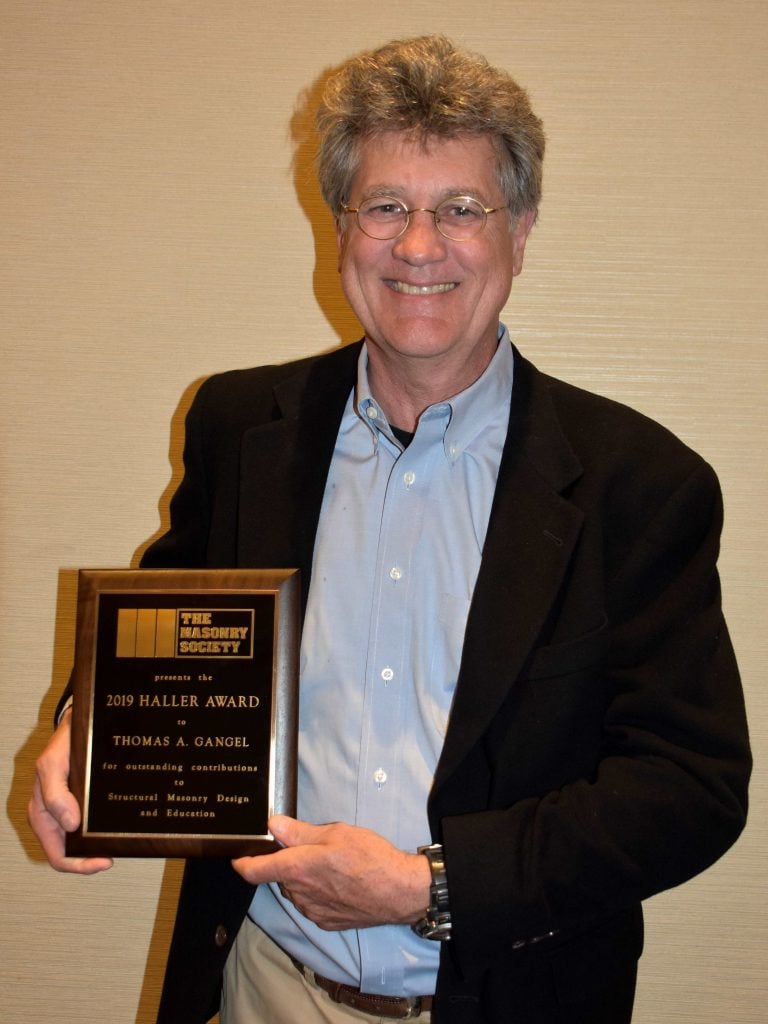
Jason Thompson was presented with the 2024 Haller Award at The Masonry Society’s Annual Meeting on October 17, 2024 in Portland, Maine. The Haller Award is given to an individual…



About Paul Haller
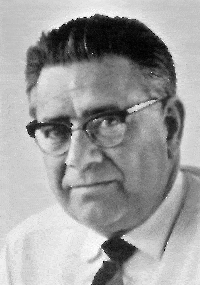
Professor Paul Haller was a dynamic engineer who helped revolutionize the design of structural masonry. Haller was born on March 7, 1902 in Zurich, Switzerland. He was formally educated at the Federal Technical University in Zurich, graduating in 1924.
After graduation, Haller worked as a practicing design engineer for several years, and then he joined the Swiss Federal Laboratory for Materials and Research. While there, he conducted extensive testing on masonry walls because after the second World War, concrete and steel materials were scarce throughout Europe. During his career, he tested over 1600 brick masonry walls, and the data from those experiments were used in the design and construction of an 18-story load-bearing brick building that consisted of walls from 12 to 15 inches in thickness. Such tall, thin walls caused nothing less than a revolution in the structural use of masonry since for the first time, a rational design method for structural masonry became possible.
In 1949, Professor Haller joined the engineering faculty at his alma mater and he became a full professor in 1966. Professor Haller retired in 1967 to enter private practice as a forensic engineer. In 1987, he died at the age of 85.