TMS eStore

  • Guide for Condition Assessment of Masonry Façades, 2017 - Download Version

    Guide for Condition Assessment of Masonry Façades, 2017 – Download Version

    $20.00

    The Masonry Society’s “Guide for Condition Assessment of Masonry Facades” is a living document that describes methodology for inspection and assessment of masonry facades. The Guide is useful to building owners, architects, engineers, and building officials as a valuable tool for masonry façade evaluations related to façade ordinances, restoration and repairs, maintenance programs, and due diligence reports. Starting with a discussion of the factors that affect masonry performance, the Guide continues through the process of masonry façade inspection and assessment with a flow chart and outline of the various tasks and elements of a façade assessment. The Appendix includes special attention on the topics of “Distress Common to Terra Cotta Facades” and “Assessment Techniques of In-Place Masonry”.


    Other Formats:  Printed Copy


  • Masonry Basics - 2nd Edition Cover

    Masonry Basics, 2nd Edition

    $35.00

    Masonry Basics, 2nd Edition has been completely revised and updated. It serves as an introduction to masonry design and construction. The various component materials, the ways in which the components are assembled to form the masonry construction, and the weather-resistance and structural implications of the various types of masonry assemblies are described. Highlights of quality assurance and quality control issues are addressed and a few of the most common types of potential deficiencies in masonry construction are described so they can be avoided. Finally, a glossary of masonry terms used in the text is provided.

    Masonry Basics can serve as a beginning text for architects, engineers, contractors, building officials, inspectors, building owners, or anyone else who wants to learn the basics of this industry.


    Member and bulk discounts discounts are available for this product.
    Click here to learn about membership.


    Other Formats:  Protected Download (Single User)


  • Masonry is Sustainable Brochure (2018)

    Masonry is Sustainable Brochure (2018)

    $0.00

    This updated publication reviews the positive environmental attributes of masonry products, and how they apply within the LEED v4 rating system, and beyond LEED with a broader approach to sustainable buildings.

  • Direct Design Handbook for Masonry Structures, 2013 - Download Version

    Direct Design Handbook for Masonry Structures, 2013 – Download Version

    $55.00

    This Direct Design Handbook for Masonry Structures outlines a direct procedure for the structural design of single-story, concrete masonry structures.


    Other Formats:  Printed Copy


    This product is provided as a secure PDC file and can only be opened through the Locklizard Safeguard Viewer. Other PDF Viewers will not be able to read this file. This document can only be opened by a single user and allows limited printing of up to 2 watermarked copiesRead more about these limitations.

  • Masonry: The First 10,000 Years Slideshow (PowerPoint for Instructors)

    Masonry: The First 10,000 Years Slideshow (PowerPoint for Instructors)

    $25.00
    This product includes the PowerPoint file for Masonry: The First 10,000 Years. The script and PDF handout for this slideshow are already included in Lectures 1 & 2 of Masonry Course Notes, 2016 Edition.

    This product provides 3 files:


    This 88-slide presentation on the history of masonry was originally prepared as the first two lectures of a semester-long course in masonry engineering at the University of Texas at Austin. It was intended to give students an appreciation for the background of masonry construction. This presentation can be used for a variety of audiences, including architects, engineers, and the public in general.

    Prepared By: Richard E. Klingner and Clayford T. Grimm.

  • Plan Set with Sample Quiz (Electronic)

    Plan Set with Sample Quiz (Electronic)

    $100.00

    This package includes a set of basic structural plans with a sample quiz to help prepare candidates for the plan reading portion of the ICC/TMS Structural Masonry Special Inspection Examination. The sample quiz includes 8 questions with answers based on the plan set.


    This product is provided as a secure PDC file and can only be opened through the Locklizard Safeguard Viewer. Other PDF Viewers will not be able to read this file. This document can only be opened by a single user and allows limited printing of up to 2 watermarked copiesRead more about these limitations.

    Physical plan sets can be printed on demand. Contact TMS to purchase a printed plan set. Additional shipping & handling charges apply.

  • All Crcked Up Over Icr

    All Crcked Up Over Icr

    $25.00 (PDF)

    Author: Richard M. Bennett

    TMS Journal Volume 42, December 31, 2024

    Abstract

    TMS 402-22 provides an equation for determining the cracked moment of inertia of a reinforced masonry wall under out-of-plane loading. TMS 402-22 states that the equation is valid for a fully grouted wall or a partially grouted wall with the neutral axis in the face shell. Other implicit assumptions that are not stated in TMS 402-22 are that the tension reinforcement has yielded, there is only one layer of tension reinforcement, and the axial load can be replaced by equivalent reinforcement at the mid-depth of the section, with the area of the reinforcement being the factored axial load divided by the yield stress. This paper provides equations for the cracked moment of inertia when these assumptions are not met. Tips for design are also provided.

    Keywords: Masonry design, out-of-plane, cracked moment of inertia, reinforced masonry


  • Comparison of Masonry Beam Design and Detailing Provisions

    Comparison of Masonry Beam Design and Detailing Provisions

    $25.00 (PDF)

    Authors: Ece Erdogmus, Richard Bennett, Jason Thompson, Bennett Banting

    TMS Journal Volume 42, December 31, 2024

    Abstract

    This work is one of the four companion papers associated with the Canada/US (CANUS) collaborative project: Harmonization of Canadian and American Masonry Structures Design Standards. This particular paper specifically delves into a comparison of the design and detailing provisions for masonry beams in the U.S. and Canada. The scope of the investigation covers the similarities and divergences between the two design standards (CSA S304-14 and TMS 402-16), through first a comparative discussion of the provisions followed by parametric studies that illustrate the differences quantitatively.

    Several areas of further investigation are identified as a result of this work, which if addressed, may improve and harmonize the two standards and practices. For instance, the χ factor utilized in CSA S304-14 amplifies the divergence such that most masonry beam designs that have been safely constructed in the U.S. are not possible in Canada. In contrast, TMS 402-16 does not have clear guidance on deflection limits or intermediate reinforcement for regular beams; and a reconsideration for modulus of rupture values may be warranted, as the code- provided values are based on historic wallette tests instead of beams.

    Keywords: Masonry beams, flexure, modulus of rupture, strength design, TMS 402, CSA S304


  • Comparison of Out-of-Plane Reinforced Masonry Wall Design Provisions

    Comparison of Out-of-Plane Reinforced Masonry Wall Design Provisions

    $25.00 (PDF)

    Heather Sustersic, David Stubbs, Russ Peterson, Richard M. Bennett, Clayton Pettit, Bart Flisak, Ece Erdogmus, Jason Thompson, Semsi Coskun, Bennett Banting, Carlos Cruz-Noguez

    TMS Journal Volume 42, December 31, 2024

    Abstract

    As part of a larger project jointly sponsored by the National Concrete Masonry Association (NCMA) Foundation, Canadian Concrete Masonry Producers Association (CCMPA), Canada Masonry Design Centre (CMDC) and Canadian Standards Association (CSA), a team of engineers and researchers from U.S. and Canada worked together to examine the key differences and similarities between the design provisions for reinforced masonry walls subject to out-of-plane (OOP) and axial loads. The scope was limited to the strength design provisions of TMS 402-16 and the limit state design provisions of CSA S304-14 masonry design standards. Several parametric studies were conducted to quantify the comparisons, as well as to identify possible limitations within each code. These studies explored factors that directly impact the calculation of combined flexural and axial capacity, wall stiffness, second-order moments, and shear capacity of the masonry walls subjected to OOP loading. Parameters considered include the compressive strength of the masonry assembly, wall geometry, as well as the size, strength and spacing of the steel reinforcement. In general, it was found that the Canadian provisions are more conservative than those in the U.S. The paper also provides a list of areas of further research or code revisions that should be considered in the future. It is the team’s goal to propose improvements to both codes as a result of this work.

    Keywords: Flexure, Axial Capacity, Out-of-Plane Resistance of Walls, Reinforced Masonry Walls, Strength Design, TMS 402, CSA S304


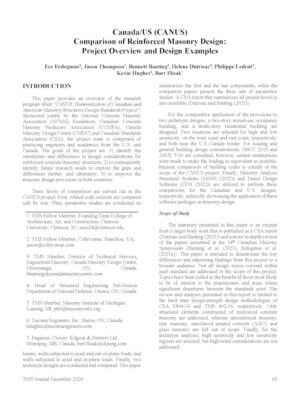
  • Comparison of Reinforced Masonry Design: Project Overview and Design Examples

    Comparison of Reinforced Masonry Design: Project Overview and Design Examples

    $25.00

    Authors: Ece Erdogmus, Jason Thompson, Bennett Banting, Helene Dutrisac, Philippe Ledent, Kevin Hughes, Bart Flisak

    TMS Journal Volume 42, December 31, 2024

    Abstract

    This work is the first one of the four companion papers associated with the Canada/US (CANUS) collaborative project: Harmonization of Canadian and American Masonry Structures Design Standards. This paper provides an overview of the key differences in reinforced concrete masonry design provisions between the two countries. The first part of the paper summarizes these differences in a discussion format, while the second part provides two design examples: a two-story mixed-use occupancy building and a multi-story residential building. Two locations are selected for high and low seismicity. While the critique of the building codes is out of the scope of this study, when appropriate, differences regarding the loading considerations from NBCC 2015 and ASCE 7-16 are highlighted. In some cases, the corresponding design checks align closely between the two countries’ design standards, while in other cases there are minor to significant differences. There are also instances where one of the standards is silent on a topic while the other addresses it comprehensively. In general, it is observed that TMS 402-16 allows a larger applicability of masonry design compared to CSA S304-14 due to the compounding effect of lower trust in masonry’s material strength and stricter considerations in design equations.

    Keywords: Reinforced masonry design, masonry codes, compressive strength of masonry, TMS 402-16, CSA S304-14


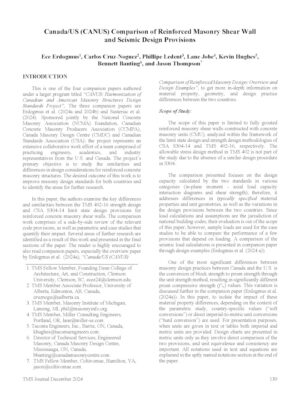
  • Comparison of Reinforced Masonry Shear Wall and Seismic Design Provisions

    Comparison of Reinforced Masonry Shear Wall and Seismic Design Provisions

    $25.00 (PDF)

    Authors: Ece Erdogmus, Carlos Cruz-Noguez, Phillipe Ledent, Lane Jobe, Kevin Hughes, Bennett Banting, Jason Thompson

    TMS Journal Volume 42, December 31, 2024

    Abstract

    As part of a larger project titled, CANUS: Harmonization of Canadian and American Masonry Structures Design Standards Project, in this paper, the design provisions in TMS 402-16 and CSA S304-14 are compared for reinforced concrete masonry shear walls subject to in-plane forces. The scope of the work covers in-plane bending and axial force interactions, shear capacity calculations, and seismic provisions for fully grouted reinforced concrete masonry shear walls. Seven parametric studies and two case studies are utilized to quantify the impact of some of the differences. The parametric studies include exploration of the effects of the wall aspect ratio, compressive strength of masonry, maximum reinforcement limitations and ductility requirements, material or capacity reduction factors, maximum compressive strain, and the artificial moment arm reduction considerations, as well as seismic wall categories and prescriptive seismic detailing requirements. The authors find that in most cases, the Canadian approach is more conservative than the U.S. The main contributor to this discrepancy is a large difference in the typical masonry compressive strength (f’m) values used in Canada and the U.S. By contrast, the maximum reinforcement ratio combined with a lower maximum strain in U.S. design can limit the height of reinforced masonry walls, especially in high seismic areas. The main product of this project is a list of potential future research studies for the resolution of some of the issues highlighted in this paper that can help improve and harmonize both countries’ masonry design provisions.

    Keywords: Reinforced masonry shear walls, TMS 402, CSA S304, In-plane behavior of masonry shear walls, Seismic design of shear walls


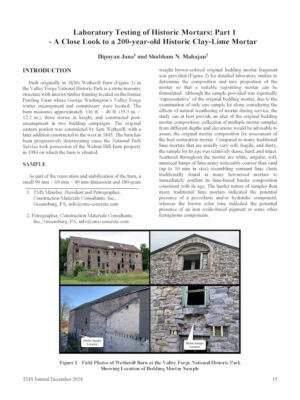
  • Laboratory Testing of Historic Mortars: Part 1 – A Close Look to a 200-year-old Historic Clay-Lime Mortar

    Laboratory Testing of Historic Mortars: Part 1 – A Close Look to a 200-year-old Historic Clay-Lime Mortar

    $25.00 (PDF)

    Authors: Dipayan Jana, Shubham N. Mahajan

    TMS Journal Volume 42, December 31, 2024

    Abstract

    A large stone barn built in 1820s in the Valley Forge historic national park in Pennsylvania used some of the early historic lime mortars in the US masonry construction during the time when natural cement was just produced in the US and about to gain its momentum for next 70 years, and Portland cement, though formulated in Europe, didn’t enter the US market for at least 50 years. A brown original fist-size bedding mortar fragment was examined, which showed many interesting microstructures of a clay-mixed historic lime mortar. The fragment was examined by a plethora of analytical techniques encompassing optical and scanning electron microscopy and microanalysis, acid digestion, chemical (gravimetric) analysis, XRD, XRF, thermal studies (TGA, DSC, DTG), FTIR, and ion chromatography. Such a comprehensive investigation provided detailed information about the mortar type, composition, and grain size distribution of masonry sand, original non-hydraulic dolomitic lime plus clay-based binder compositions and resultant microstructure of paste, origin of lime lumps, along with evidence of any distress and alterations from two centuries of exposures to a moist outdoor environment. Based on all these studies, the overall condition, extent of deterioration/alterations, and sand and binder proportions of the original mortar were assessed by reverse engineering, from which a suitable replacement mortar was recommended for long-term restoration.

    Keywords: Microscopy, petrography, masonry, historic mortar, lime


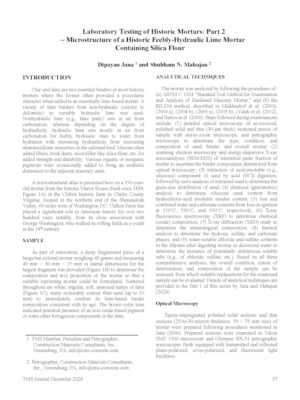
  • Laboratory Testing of Historic Mortars: Part 2 – Microstructure of a Historic Feebly-Hydraulic Lime Mortar Containing Silica Flour

    Laboratory Testing of Historic Mortars: Part 2 – Microstructure of a Historic Feebly-Hydraulic Lime Mortar Containing Silica Flour

    $25.00 (PDF)

    Authors: Dipayan Jana, Shubham N. Mahajan

    TMS Journal Volume 42, December 31, 2024

    Abstract

    A large stone barn built in 1820s in the Valley Forge historic national park in Pennsylvania used some of the early historic lime mortars in the US masonry construction during the time when natural cement was just produced in the US and about to gain its momentum for next 70 years, and Portland cement, though formulated in Europe, didn’t enter the US market for at least 50 years. A brown original fist-size bedding mortar fragment was examined, which showed many interesting microstructures of a clay-mixed historic lime mortar. The fragment was examined by a plethora of analytical techniques encompassing optical and scanning electron microscopy and microanalysis, acid digestion, chemical (gravimetric) analysis, XRD, XRF, thermal studies (TGA, DSC, DTG), FTIR, and ion chromatography. Such a comprehensive investigation provided detailed information about the mortar type, composition, and grain size distribution of masonry sand, original non-hydraulic dolomitic lime plus clay-based binder compositions and resultant microstructure of paste, origin of lime lumps, along with evidence of any distress and alterations from two centuries of exposures to a moist outdoor environment. Based on all these studies, the overall condition, extent of deterioration/alterations, and sand and binder proportions of the original mortar were assessed by reverse engineering, from which a suitable replacement mortar was recommended for long-term restoration.

    Keywords: Microscopy, petrography, masonry, lime


  • TMS 402/602-92 Building Code Requirements and Specification for Masonry Structures (PDF)

    TMS 402/602-92 Building Code Requirements and Specification for Masonry Structures (PDF)

    $10.00

    Building Code Requirements for Masonry Structures (ACI 530-92/ASCE 5-92/TMS 402-92) and Specifications for Masonry Structures (ACI 530.1-92/ASCE 6-92/TMS 602-92)

  • ACI-TMS CODE 216.1-14 Code Requirements for Determining Fire Resistance of Concrete and Masonry Construction Assemblies

    ACI-TMS CODE 216.1-14 Code Requirements for Determining Fire Resistance of Concrete and Masonry Construction Assemblies

    $71.50

    Fire resistance of building elements is an important consideration in building design. While structural design considerations for concrete and masonry at ambient temperature conditions are addressed by ACI 318 and TMS 402/ACI 530/ASCE 5, respectively, these codes do not consider the impact of fire on concrete and masonry construction. This standard contains design and analytical procedures for determining the fire resistance of concrete and masonry members and building assemblies. Where differences occur in specific design requirements between this standard and ACI 318 and TMS 402/ACI 530/ASCE 5, as in the case of cover protection of steel reinforcement, the more stringent of the requirements shall apply.

    Errata as of 2017-10-20


    Other Formats:  Protected Download (Single User)


  • Design and Construction Guidelines for Dry-Stack Concrete Masonry

    Design and Construction Guidelines for Dry-Stack Concrete Masonry

    $32.00

    This guide covers the design and construction of dry-stack concrete masonry structures constructed from hollow units. Among the subjects covered are history and background, fire resistance, design, construction, quality assurance, materials, surface-bonding, placement of embedded items, analysis, strength and serviceability, flexural and axial loads, shear, details and development of reinforcement, walls, and seismic design requirements.

    Dry-stack masonry construction, which consists of individual masonry units placed without the use of mortar in the head and bed joints, is one of the earliest forms of construction. Despite its historical use, there is little in the way of contemporary design and construction guidance in the United States on the use of dry-stack masonry systems for structural applications. Because the majority of dry-stack research has been limited to reinforced or prestressed concrete masonry construction, the scope of this guide is limited to reinforced or prestressed, dry-stack construction of concrete masonry units.


    Other Available Formats


  • TMS 402/602-08 Building Code Requirements and Specification for Masonry Structures, 2008 (MSJC 2008)

    TMS 402/602-08 Building Code Requirements and Specification for Masonry Structures, 2008 (MSJC 2008)

    $100.00

    The Masonry Standards Joint Committee’s (MSJC) 2008 Building Code Requirements and Specification for Masonry Structures (TMS 402/ACI 530/ASCE 5 and TMS 602/ACI 530.1/ASCE 6) and Commentaries are referenced by the 2009 International Building Code (IBC).

    This edition of the national masonry design code and minimum specification includes numerous changes and enhancements from earlier editions including provisions on self consolidating grout, reformatted and clearer seismic design requirements, revised anchor bolt capacity equations, and defined inspection frequencies of key aspects of masonry construction.

    This edition includes bleed tabs, revision bars, deletion arrows and movement boxes so that users of the 2005 MJSC will be able to quickly identify sections that have been substantively modified.


    Other Formats:  Protected Download (Single User)


  • Masonry is Sustainable Brochure (2014)

    Masonry is Sustainable Brochure (2014)

    $0.00

    This publication reviews the positive environmental attributes of masonry products, both within the LEED rating system, and beyond LEED with a broader approach to sustainable buildings.


  • BIM for Masonry Modeling Masonry Buildings in Autodesk Revit

    BIM for Masonry Modeling Masonry Buildings in Autodesk Revit

    $0.00

    The Building Information Modeling for Masonry Initiative has created this guide to provide architects, engineers, and mason contractors with tools for developing Autodesk Revit models for modeling masonry buildings. Industry experts from CAD Technology Center (CTC) and Integrus Architecture developed building models and narratives that summarize their work and experience

  • TMS 402/602-13 Building Code Requirements and Specification for Masonry Structures (MSJC 2013)

    TMS 402/602-13 Building Code Requirements and Specification for Masonry Structures (MSJC 2013)

    $124.00

    TMS 402-13/ACI 530-13/ASCE 5-13 and TMS 602-13/ACI 530.1-13/ASCE 6-13.

    The 2013 edition of Building Code Requirements and Specification for Masonry Structures introduced major technical and organizational updates from the 2011 edition and is referenced by the 2015 International Building Code (IBC) for the design and construction of structural masonry, masonry veneer, and glass unit masonry.

    Key changes include a complete reformatting for improved usability, a new appendix introducing an optional limit design method for special reinforced masonry shear walls, and a new prescriptive design chapter for partition walls. Additional updates cover moment magnifier provisions for reinforced masonry, revised design rules for partially grouted shear walls, and enhanced veneer requirements for seismic design categories D, E, and F.

    Published jointly by TMS, ACI, and ASCE, this edition provides a coordinated and authoritative standard for masonry design and construction under the 2015 IBC.


    Available Formats

    Choose from print, digital, or online access through TMS or our distribution partners:

    Access Type Through TMS Through Partners
    Print Hard Copy
    Online Access Annual Subscription
    Subscribe through MADCAD
    Download PDC Format
    Sold by TMS · Requires Locklizard Safeguard Viewer
    PDF Format
    Sold by Accuris · Requires FileOpen plugin
  • TMS 402/602-11 Building Code Requirements and Specification for Masonry Structures, 2011 (MSJC 2011)

    TMS 402/602-11 Building Code Requirements and Specification for Masonry Structures, 2011 (MSJC 2011)

    $110.00

    The Masonry Standards Joint Committee’s (MSJC) 2011 Building Code Requirements and Specification for Masonry Structures (TMS 402/ACI 530/ASCE 5 and TMS 602/ACI 530.1/ASCE 6) and Commentaries are referenced by the 2012 International Building Code (IBC).

    This edition represents a major update from the 2008 edition both in technical requirements and in layout. It has been updated to be consistent with the requirements in ASCE 7-10, Minimum Design Loads for Buildings and Other Structures.


    Member and bulk discounts discounts are available for this product.
    Click here to learn about membership.


    Other Formats:  Protected Download (Single User)


  • Placeholder

    New TMS Membership

    Price range: $40.00 through $2,250.00

    Membership Classifications & Dues Rates Sustaining Organization ($2,250) An individual or organization with an interest in the goals and activities of the Society and who wishes to make a significant…

    Select optionsLoading Done This product has multiple variants. The options may be chosen on the product page
  • TMS 402/602-16 Online - Annual Subscription

    TMS 402/602-16 Online – Annual Subscription

    $150.00 for 1 year

    The Masonry Standards Online version of TMS 402/602 has additional features not available with the download version, including:

    • Copy – Copy text, equations, tables, and figures
    • Print – Print sections from the standard and commentary
    • Internal linking – Quickly jump to a referenced sections, figures, tables, or equations
    • Share – Share links to specific sections within the standard or commentary
    • Highlight and annotate – Highlight, annotate, and add notes to refer to later
    • Notation and definition tooltips – Hover over terms and notation to display helpful tooltips with definitions
    • Multi-user options – See below for more information
    • and more!

    View a quick tutorial for navigating MSO below.

    Preview Chapter 1 of TMS 402


    TMS Members

    50% off all subscriptions + multi-user discounts

    Non-Members

    40% off an annual subscription by adding it to your cart along with either a hard copy or digital copy

    Subscription does not auto-renew


    Other Formats

    TMS 402/602-16 Only

    Select the number of users/seats:

  • TMS Journal

    TMS Journal, Vol. 33, No. 1

    $75.00

    TMS Journal, Vol. 33, No. 1 was published in December 2015.

  • Sale! TMS Responds, Vol. 14, No. 1

    TMS Responds, Vol. 14, No. 1

    Original price was: $10.00.Current price is: $0.00.

    TMS Responds is a resources developed to help answer common, and sometimes, not so common questions on masonry materials, design, construction, evaluation, and repair. This issues responds to questions about masonry detailing.

    Vol. 14, No. 1 (March 2016) responds to questions on:

    • Detailing Vertical Reinforcement
    • Masonry Detailing
  • TMS eJournal, Vol. 1, No. 1

    TMS eJournal, Vol. 1, No. 1

    $75.00

    TMS Journal, Vol. 1, No. 1, January-June 1981 contains:

    • Prelaid Masonry Panels on Multi-story Buildings, K. Bailey
    • Yugoslavian Research Conference on Earthquake Engineering, J. E. Amrhein
    • Glossary of Masonry Terms
    • A Practical Methodology for the Design of Masonry Walls, J. Colville
    • Effect of the Aspect Ratio of the Unit on Flexural Tensile Strength of Brick Masonry,  A. Hamid
    • Modern Masonry Structures and Their Weather Resistance, P. T. Mikluchin

    Please be advised that this is photocopy scan and is accordingly not searchable.

  • TMS eJournal, Vol. 3, No. 1

    TMS eJournal, Vol. 3, No. 1

    $75.00

    TMS Journal, Vol. 3, No. 1, January-June 1984 contains:

    • An Overview of Research Projects on Strengthening Masonry Buildings in the United States, J. B. Scalzi
    • ASTM Standards for the Masonry Industry, J. Heslip
    • Nonparametric Tests of Energy Consumption in Brick Frame Residences, J. Dituri, R. E. Turley and W. J. Kennedy
    • Failure of Acrylic Paint and Sealers over Stone and Brick Masonry, S. L. Marusin

    Please be advised that this is photocopy scan and is accordingly not searchable.

  • TMS eJournal, Vol. 2, No. 1

    TMS eJournal, Vol. 2, No. 1

    $75.00

    TMS Journal, Vol. 2, No. 1, January-June 1982 contains:

    • A Truly Heavy Hobby, R. P. Anjaro, SR.
    • Measured Earthquake Response of a Concrete Block Masonry Shear Wall Building, G. C. Hart and S. C. Huang

    Please be advised that this is photocopy scan and is accordingly not searchable.

  • TMS eJournal, Vol. 2, No. 2

    TMS eJournal, Vol. 2, No. 2

    $75.00

    TMS Journal, Vol. 2, No. 2, January-June 1983 contains:

    • Behavior of Hollow Concrete Masonry Prisms Under Axial Load and Bending, I. J. Besica and H.G. Harris
    • Measurment of the Creep Strain Distribution in an Axially Loaded Brickwork Wall, D. Warren and D. Lenczner

    Please be advised that this is photocopy scan and is accordingly not searchable.

  • TMS eJournal, Vol. 2, No. 3

    TMS eJournal, Vol. 2, No. 3

    $75.00

    TMS Journal, Vol. 2, No. 3, July-December 1983 contains:

    • Variability of Reinforced Concrete Masonry Beam Strength in Flexure and Shear, H. Keller and G.T. Suter
    • Behavior of Floor-to-Wall Connections in Concrete Masonry Buildings, A. Anuar, S.K. Arya and G.A. Hegemier
    • An Earthquake Design Equation for Shear Walls in Shear, G.C. Hart, S.C. Huang, R.E. Englekirk, and S. Dow

    Please be advised that this is photocopy scan and is accordingly not searchable.
  • TMS eJournal, Vol. 1, No. 2

    TMS eJournal, Vol. 1, No. 2

    $75.00

    TMS Journal, Vol. 1, No. 2, July-December 1981 contains:

    • Slender Walls Research Program by California Structural Engineers, J.E. Amrhein
    • Distribution of Lateral Forces in Multistory Masonry Shear Wall Systems, L. Cerny and C. Baldridge
    • Analysis of the Diametral Masonry Core Shear Test Specimen, R. H. Atkinson
    • Torsional Strength of Brick Masonry Joints, A. A. Hamid and M. E. Tate
    • Ductility of Unconfined and Confined Concrete Masonry Shear Walls, M. J. N. Priestly

    Please be advised that this is photocopy scan and is accordingly not searchable.

  • TMS eJournal, Vol. 3, No. 2

    TMS eJournal, Vol. 3, No. 2

    $75.00

    TMS Journal,Vol. 3, No. 2, July-December 1984 contains:

    • Long Beach 1333 Coalinga 1983 But with a Difference, J. E. Amrhein and J. A. Giron
    • Hurricane Alicia Tests Materials in Materials in Houston’s Skyline, J. G. Borchelt and F.S. Pongette
    • Investigation of the Interface between Brick and Mortar, G. W. Chase
    • Effect of Grouting on the Flexural Tensile Strength of Concrete Block Masonry, R. G. Drysdale and A.A. Hamid

    Please be advised that this is photocopy scan and is accordingly not searchable.