TMS eStore

  • TMS 402/602-92 Building Code Requirements and Specification for Masonry Structures (PDF)

    TMS 402/602-92 Building Code Requirements and Specification for Masonry Structures (PDF)

    $10.00

    Building Code Requirements for Masonry Structures (ACI 530-92/ASCE 5-92/TMS 402-92) and Specifications for Masonry Structures (ACI 530.1-92/ASCE 6-92/TMS 602-92)

  • Masonry Designers' Guide – 2022

    Masonry Designers’ Guide – 2022

    $220.00

    The Masonry Designers’ Guide – 2022 (MDG-2022) is a companion resource to TMS 402/602-22, offering practical guidance and more than 150 detailed design examples to help users confidently apply the latest masonry code and specification provisions.

    Developed for engineers, architects, contractors, inspectors, building officials, and educators, this comprehensive reference begins with foundational chapters on materials, testing, quality assurance, quality control, and construction methods, each aligned with specific sections of TMS 402-22 and TMS 602-22. Subsequent chapters illustrate key design concepts and show how to apply the Code to the structural design of beams, walls, columns, and other masonry members.

    The MDG-2022 also addresses masonry provisions in the 2024 International Building Code (IBC) and reflects updates in ASCE/SEI 7-22, ensuring alignment with current U.S. design standards.

    Highlights of the 2022 Edition
      • 150+ worked examples covering concrete and clay masonry, autoclaved aerated concrete (AAC), prestressed masonry, glass unit masonry, and more.
      • 60+ comprehensive building design examples in Chapters 19–21, illustrating full designs for three representative masonry buildings.

    <li”>

    New examples on GFRP-reinforced masonry, masonry veneer, anchor bolts, and other recently introduced topics.

    • Fully updated references and expanded commentary to clarify practical application of TMS 402/602-22 requirements.

    For a closer look, view sample pages and example summaries at the bottom of this page.


    Available Formats

    Choose from print, digital, or online access through TMS or our distribution partners:

    Access Type Through TMS Through Partners
    Print Hard Copy
    Online Access Annual Subscription
    Subscribe through MADCAD
    Download PDC Format
    Sold by TMS · Requires Locklizard Safeguard Viewer
    PDF Format
    Sold by Accuris · Requires FileOpen plugin
  • Masonry Designers' Guide – 2022 Download Version

    Masonry Designers’ Guide – 2022 Download Version

    $220.00

    The Masonry Designers’ Guide – 2022 (MDG-2022) is a companion resource to TMS 402/602-22, offering practical guidance and more than 150 detailed design examples to help users confidently apply the latest masonry code and specification provisions.

    Developed for engineers, architects, contractors, inspectors, building officials, and educators, this comprehensive reference begins with foundational chapters on materials, testing, quality assurance, quality control, and construction methods, each aligned with specific sections of TMS 402-22 and TMS 602-22. Subsequent chapters illustrate key design concepts and show how to apply the Code to the structural design of beams, walls, columns, and other masonry members.

    The MDG-2022 also addresses masonry provisions in the 2024 International Building Code (IBC) and reflects updates in ASCE/SEI 7-22, ensuring alignment with current U.S. design standards.

    Highlights of the 2022 Edition
    • 150+ worked examples covering concrete and clay masonry, autoclaved aerated concrete (AAC), prestressed masonry, glass unit masonry, and more.

    • 60+ comprehensive building design examples in Chapters 19–21, illustrating full designs for three representative masonry buildings.

    • New examples on GFRP-reinforced masonry, masonry veneer, anchor bolts, and other recently introduced topics.

    • Fully updated references and expanded commentary to clarify practical application of TMS 402/602-22 requirements.

    For a closer look, view sample pages and example summaries at the bottom of this page.


    Available Formats

    Choose from print, digital, or online access through TMS or our distribution partners:

    Access Type Through TMS Through Partners
    Print Hard Copy
    Online Access Annual Subscription
    Subscribe through MADCAD
    Download PDC Format
    Sold by TMS · Requires Locklizard Safeguard Viewer
    PDF Format
    Sold by Accuris · Requires FileOpen plugin

    ⚠️ Digital Download Terms & Software Requirements

    Before purchasing a digital download, please review these requirements and restrictions:

    • Single-user access only. The document license is linked to the purchasing user account.
    • For multi-user access, please visit one of the partners listed above.
    • Delivered as a secure PDC file – requires Locklizard Safeguard Viewer.
      Other PDF viewers will not open this file.
    • Allows printing of up to two watermarked copies (the document can be printed twice).
      Contact TMS to inquire about adding prints at no cost.
    • Read more about these limitations.

    Need help? Email accounting@temp.masonrysociety.org.

    If you have difficulty or are not satisfied with the digital version, we’re happy to exchange it for a hard copy or issue a refund. Just reply to your receipt, or message the email above.

  • TMS eJournal, Vol. 41, No. 1

    TMS eJournal, Vol. 41, No. 1

    $75.00

    Technical Papers

    • Artificial Neural Network to Predict the Shear Strength of Partially Grouted Masonry Walls
      By: Jeffrey Hung, Bennett Banting, Cristián Sandoval, and Carlos Cruz-Noguez
    • Flexural Bond Strength of Masonry Assemblies with Lightweight Grout
      By: Cooper Banks, Laura Redmond, Ben Hiner, Stephen Wright, and Michael Stoner
    • High-Strength Reinforcing Bars (HSRBs) and TMS 402
      By: Omar Khalid and Dimitrios Kalliontzis

    Award Winning NAMC Papers

    • Seismic Out-of-Plane Retrofit of URM Walls Using Timber Strong-Backs
      By: Ivan Giongo, Dmytro Dizhur, Jason Ingham, Robert Hudson, Marta Giaretton
    • An Analysis Model for Partially Grouted Shear Walls Using Macro-Modelling: Importance of Reporting Joint Shear Strength
      By: Amr Ba Rahima, Clayton Pettit, Carlos Cruz Noguez, Jeffrey Hung
    • Shake Table Tests of Traditional Timber Frame Masonry Construction System
      By: Aanisa Gania, Durgesh C Rai, Jan Mohammad Banday
    • Sensitivity Analysis of Parameters on the In Plane Behavior of Unreinforced Masonry Wall Strengthened with Steel Wire Reinforced Cementitious Matrix (SWRCM)
      By: Dattatreya Tripathy and Vaibhav Singhal
    • Preserving a Landmark: Saving a Historic Masonry Landmark with Cost Saving Restoration Construction Practices
      By: Nathan Harres and Ariel Kousgaard
  • TMS 402/602-22 Online - Annual Subscription

    TMS 402/602-22 Online – Annual Subscription

    $200.00 for 1 year

    The Masonry Standards Online (MSO) edition of TMS 402/602 transforms how you access and use the masonry code. Go beyond static downloads with powerful digital tools designed to make your work faster, easier, and more connected.

    • Copy & Print with Ease – Copy text, equations, and figures or print the sections you need, when you need them.
    • Instant Navigation – Jump directly to referenced sections, tables, or figures with one click.
    • Shareable Links – Send colleagues a direct link to any section of the Code or Commentary.
    • Highlight & Annotate – Mark up key passages and add your own notes for future reference.
    • Smart Definitions – Hover over notations and terms to see definitions instantly.
    • Multi-User Access – Flexible options for firms, institutions, and teams.
    • and much more.

    Ready to take a closer look? Preview Chapter 1 of TMS 402-22.


    Available Formats

    Choose from print, digital, or online access through TMS or our distribution partners:

    Access Type Through TMS Through Partners
    Print Hard Copy
    Online Access Annual Subscription
    Subscribe through TMS
    Annual Subscription
    Subscribe through MADCAD
    Download PDC Format
    Sold by TMS · Requires Locklizard Safeguard Viewer
    PDF Format
    Sold by Accuris · Requires FileOpen plugin

    Exclusive Discounts

    Enjoy special savings on Masonry Standards Online:

    • TMS Members: Get 50% off all subscriptions, plus additional savings on multi-user licenses.
    • Non-Members: Save 40% on an annual subscription when you purchase it with a hard copy or download.

    Join today to get the best value!


    Select the number of users/seats:

    Multi-user access lets several people, devices, or browsers use the same subscription at once through concurrent logins. See below for more information.
    This subscription is for a one-year term and does not auto-renew.
  • ACI-TMS CODE 122.2-24 Thermal Properties of Concrete and Masonry for Use in Determining Energy Code Compliance for Low-Rise Residential Buildings — Download Version

    ACI-TMS CODE 122.2-24 Thermal Properties of Concrete and Masonry for Use in Determining Energy Code Compliance for Low-Rise Residential Buildings — Download Version

    $99.00

    This Code prescribes minimum design and construction requirements for energy efficiency of building envelopes of new buildings and additions to buildings. It applies to buildings having concrete walls, roofs, or floors; masonry walls; and masonry veneer, including veneer attached to frame walls as part of the building envelope. It also provides minimum thermal properties for these assemblies for code compliance. This Code is applicable to low-rise residential buildings that use either electricity from any generation source or fossil fuel. It can be used with applicable energy codes and standards such as the International Energy Conservation Code (IECC).

    This protected download cannot be printed.

  • Standards for Architectural Cast Stone, 2023 Edition Online – Annual Subscription

    Standards for Architectural Cast Stone, 2023 Edition Online – Annual Subscription

    $90.00 for 1 year

    Standards for Architectural Cast Stone contains three standards and their commentaries:

    • Standard for Design of Architectural Cast Stone (TMS 404)
    • Standard for Fabrication of Architectural Cast Stone (TMS 504)
    • Standard Specification for Installation of Architectural Cast Stone (TMS 604)

    Key updates and revisions incorporated by the Committee include:

    • Updates for coordination with other reference standards including updates to reflect changes in ASTM standards and reference to the 2022 edition of ASCE/SEI 7.
    • General cleanup and clarification of provisions and expanded commentary.
    • Introduced new deflection limits of l/600 for cast stone subjected to out-of-plane loads.
    • Removed the historical drying shrinkage limit of 0.000325, replaced by a requirement that drying shrinkage be tested and reported.
    • Minimum thickness requirement of 2.5 inches (64 mm) for all cast stone units.
    • Permitting the use of glass fiber reinforced polymer bars meeting ASTM D7957/C7957M.
    • Minimum qualifications for testing labs and inspection agencies are required to be defined

    Subscription does not auto-renew


    Select the number of users/seats:

  • TMS 302-18 Standard Method for Determining Sound Transmission Ratings for Masonry Assemblies Online – Annual Subscription

    TMS 302-18 Standard Method for Determining Sound Transmission Ratings for Masonry Assemblies Online – Annual Subscription

    $0.00 for 1 year

    The TMS 302 Sound Standard provides minimum requirements for rating masonry walls for sound transmission class (STC) and outdoor-indoor transmission class (OITC) based on testing calibrated calculation procedures.

    Topics covered include reference standards, definitions and notations, materials, construction, and methods to STC and OITC rating for concrete masonry and clay masonry assemblies.

    TMS 302-18 is adopted by reference in the 2021 International Building Code.


    Available through Masonry Standards Online thanks to the support of 


    Select the number of users/seats:

  • TMS eJournal, Vol. 42, No. 1

    TMS eJournal, Vol. 42, No. 1

    $75.00 (PDF)

    The Masonry Society Journal is an open forum for the presentation and discussion of masonry research and as such, welcomes papers related to the field. The following papers are included in Volume 42.

    See below for authors, abstracts, and links to purchase individual papers


    Technical Papers

    • All Crcked Up Over Icr
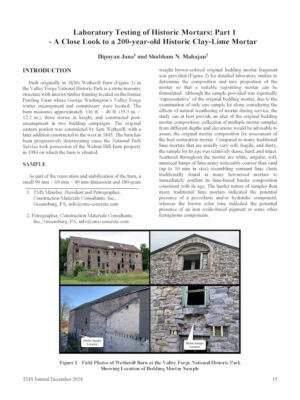
    • Laboratory Testing of Historic Mortars: Part 1 – A Close Look to a 200-year-old Historic Clay-Lime Mortar
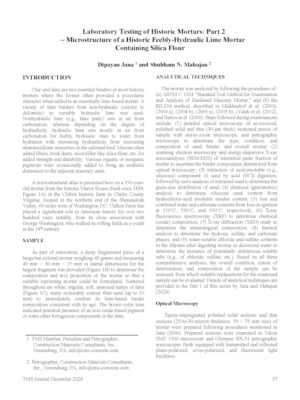
    • Laboratory Testing of Historic Mortars: Part 2 – Microstructure of a Historic Feebly-Hydraulic Lime Mortar Containing Silica Flour

    Canada/US (CANUS) Collaborative Project Papers

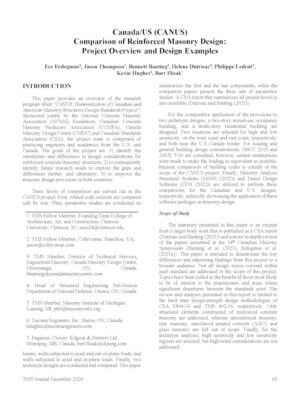
    • Comparison of Reinforced Masonry Design: Project Overview and Design Examples
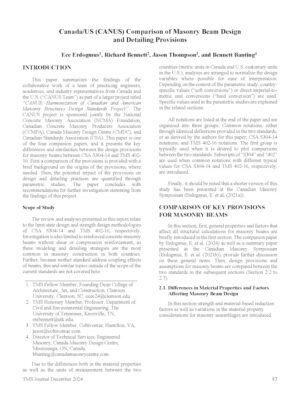
    • Comparison of Masonry Beam Design and Detailing Provisions
    • Comparison of Out-of-Plane Reinforced Masonry Wall Design Provisions
    • Comparison of Reinforced Masonry Shear Wall and Seismic Design Provisions

    A Harmonization of Canadian and American Masonry Structures Design Standards

    Funding for this project was provided jointly by the National Concrete Masonry Association Education and Research Foundation, the Canada Masonry Design Centre, the Canadian Concrete Masonry Producers Association, and the Canadian Standards Association.


  • ACI-TMS CODE-122.3-24: Thermal Properties of Concrete and Masonry for Use in Determining Energy Code Compliance Except for Low-Rise Residential Buildings — Download Version

    ACI-TMS CODE-122.3-24: Thermal Properties of Concrete and Masonry for Use in Determining Energy Code Compliance Except for Low-Rise Residential Buildings — Download Version

    $99.00

    This Code prescribes minimum design and construction requirements for energy efficiency of building envelopes of new buildings and additions to buildings. It applies to buildings having concrete walls, roofs, or floors; masonry walls; and masonry veneer, including veneer attached to frame walls as part of the building envelope. It also provides minimum thermal properties for these assemblies for code compliance.

    This Code is applicable to commercial and mid- to high-rise residential buildings that use either electricity from any generation source or fossil fuel. It can be used with applicable energy codes and standards such as ASHRAE 90.1 and the International Energy Conservation Code (IECC).

    This protected download cannot be printed.

  • Placeholder

    Sound Transmission Standard, 2nd Edition

    $30.00

    This Standard provides minimum requirements for rating masonry walls for a sound transmission class (STC) and outdoor-indoor transmission class (OITC) based on field or laboratory testing or based on a calculation procedure.

    The Standard is written as a legal document in mandatory language so that it may form a part of a legally adopted building code. The Commentary presents background details, committee considerations, and research data used to develop the Standard. Separate equations for clay and concrete masonry walls are used to reflect the varying properties of these materials related to sound transmission.

  • All Crcked Up Over Icr

    All Crcked Up Over Icr

    $25.00 (PDF)

    Author: Richard M. Bennett

    TMS Journal Volume 42, December 31, 2024

    Abstract

    TMS 402-22 provides an equation for determining the cracked moment of inertia of a reinforced masonry wall under out-of-plane loading. TMS 402-22 states that the equation is valid for a fully grouted wall or a partially grouted wall with the neutral axis in the face shell. Other implicit assumptions that are not stated in TMS 402-22 are that the tension reinforcement has yielded, there is only one layer of tension reinforcement, and the axial load can be replaced by equivalent reinforcement at the mid-depth of the section, with the area of the reinforcement being the factored axial load divided by the yield stress. This paper provides equations for the cracked moment of inertia when these assumptions are not met. Tips for design are also provided.

    Keywords: Masonry design, out-of-plane, cracked moment of inertia, reinforced masonry


  • Laboratory Testing of Historic Mortars: Part 1 – A Close Look to a 200-year-old Historic Clay-Lime Mortar

    Laboratory Testing of Historic Mortars: Part 1 – A Close Look to a 200-year-old Historic Clay-Lime Mortar

    $25.00 (PDF)

    Authors: Dipayan Jana, Shubham N. Mahajan

    TMS Journal Volume 42, December 31, 2024

    Abstract

    A large stone barn built in 1820s in the Valley Forge historic national park in Pennsylvania used some of the early historic lime mortars in the US masonry construction during the time when natural cement was just produced in the US and about to gain its momentum for next 70 years, and Portland cement, though formulated in Europe, didn’t enter the US market for at least 50 years. A brown original fist-size bedding mortar fragment was examined, which showed many interesting microstructures of a clay-mixed historic lime mortar. The fragment was examined by a plethora of analytical techniques encompassing optical and scanning electron microscopy and microanalysis, acid digestion, chemical (gravimetric) analysis, XRD, XRF, thermal studies (TGA, DSC, DTG), FTIR, and ion chromatography. Such a comprehensive investigation provided detailed information about the mortar type, composition, and grain size distribution of masonry sand, original non-hydraulic dolomitic lime plus clay-based binder compositions and resultant microstructure of paste, origin of lime lumps, along with evidence of any distress and alterations from two centuries of exposures to a moist outdoor environment. Based on all these studies, the overall condition, extent of deterioration/alterations, and sand and binder proportions of the original mortar were assessed by reverse engineering, from which a suitable replacement mortar was recommended for long-term restoration.

    Keywords: Microscopy, petrography, masonry, historic mortar, lime


  • Laboratory Testing of Historic Mortars: Part 2 – Microstructure of a Historic Feebly-Hydraulic Lime Mortar Containing Silica Flour

    Laboratory Testing of Historic Mortars: Part 2 – Microstructure of a Historic Feebly-Hydraulic Lime Mortar Containing Silica Flour

    $25.00 (PDF)

    Authors: Dipayan Jana, Shubham N. Mahajan

    TMS Journal Volume 42, December 31, 2024

    Abstract

    A large stone barn built in 1820s in the Valley Forge historic national park in Pennsylvania used some of the early historic lime mortars in the US masonry construction during the time when natural cement was just produced in the US and about to gain its momentum for next 70 years, and Portland cement, though formulated in Europe, didn’t enter the US market for at least 50 years. A brown original fist-size bedding mortar fragment was examined, which showed many interesting microstructures of a clay-mixed historic lime mortar. The fragment was examined by a plethora of analytical techniques encompassing optical and scanning electron microscopy and microanalysis, acid digestion, chemical (gravimetric) analysis, XRD, XRF, thermal studies (TGA, DSC, DTG), FTIR, and ion chromatography. Such a comprehensive investigation provided detailed information about the mortar type, composition, and grain size distribution of masonry sand, original non-hydraulic dolomitic lime plus clay-based binder compositions and resultant microstructure of paste, origin of lime lumps, along with evidence of any distress and alterations from two centuries of exposures to a moist outdoor environment. Based on all these studies, the overall condition, extent of deterioration/alterations, and sand and binder proportions of the original mortar were assessed by reverse engineering, from which a suitable replacement mortar was recommended for long-term restoration.

    Keywords: Microscopy, petrography, masonry, lime


  • Comparison of Reinforced Masonry Design: Project Overview and Design Examples

    Comparison of Reinforced Masonry Design: Project Overview and Design Examples

    $25.00

    Authors: Ece Erdogmus, Jason Thompson, Bennett Banting, Helene Dutrisac, Philippe Ledent, Kevin Hughes, Bart Flisak

    TMS Journal Volume 42, December 31, 2024

    Abstract

    This work is the first one of the four companion papers associated with the Canada/US (CANUS) collaborative project: Harmonization of Canadian and American Masonry Structures Design Standards. This paper provides an overview of the key differences in reinforced concrete masonry design provisions between the two countries. The first part of the paper summarizes these differences in a discussion format, while the second part provides two design examples: a two-story mixed-use occupancy building and a multi-story residential building. Two locations are selected for high and low seismicity. While the critique of the building codes is out of the scope of this study, when appropriate, differences regarding the loading considerations from NBCC 2015 and ASCE 7-16 are highlighted. In some cases, the corresponding design checks align closely between the two countries’ design standards, while in other cases there are minor to significant differences. There are also instances where one of the standards is silent on a topic while the other addresses it comprehensively. In general, it is observed that TMS 402-16 allows a larger applicability of masonry design compared to CSA S304-14 due to the compounding effect of lower trust in masonry’s material strength and stricter considerations in design equations.

    Keywords: Reinforced masonry design, masonry codes, compressive strength of masonry, TMS 402-16, CSA S304-14


  • Comparison of Masonry Beam Design and Detailing Provisions

    Comparison of Masonry Beam Design and Detailing Provisions

    $25.00 (PDF)

    Authors: Ece Erdogmus, Richard Bennett, Jason Thompson, Bennett Banting

    TMS Journal Volume 42, December 31, 2024

    Abstract

    This work is one of the four companion papers associated with the Canada/US (CANUS) collaborative project: Harmonization of Canadian and American Masonry Structures Design Standards. This particular paper specifically delves into a comparison of the design and detailing provisions for masonry beams in the U.S. and Canada. The scope of the investigation covers the similarities and divergences between the two design standards (CSA S304-14 and TMS 402-16), through first a comparative discussion of the provisions followed by parametric studies that illustrate the differences quantitatively.

    Several areas of further investigation are identified as a result of this work, which if addressed, may improve and harmonize the two standards and practices. For instance, the χ factor utilized in CSA S304-14 amplifies the divergence such that most masonry beam designs that have been safely constructed in the U.S. are not possible in Canada. In contrast, TMS 402-16 does not have clear guidance on deflection limits or intermediate reinforcement for regular beams; and a reconsideration for modulus of rupture values may be warranted, as the code- provided values are based on historic wallette tests instead of beams.

    Keywords: Masonry beams, flexure, modulus of rupture, strength design, TMS 402, CSA S304