Auto1

  • Sound Transmission Standard, 3rd Edition - Download Version

    Sound Transmission Standard, 3rd Edition – Download Version

    $35.00

    The updated version of this Standard provides minimum requirements for rating masonry walls for a sound transmission class (STC) and added for 2012 outdoor-indoor transmission class (OITC) based on field or laboratory testing or based on a calculation procedure.


    Other Formats:  Printed Copy


    This product is provided as a secure PDC file and can only be opened through the Locklizard Safeguard Viewer. Other PDF Viewers will not be able to read this file. This document can only be opened by a single user and allows limited printing of up to 2 watermarked copiesRead more about these limitations.

  • Guide for Condition Assessment of Masonry Façades, 2017 - Download Version

    Guide for Condition Assessment of Masonry Façades, 2017 – Download Version

    $20.00

    The Masonry Society’s “Guide for Condition Assessment of Masonry Facades” is a living document that describes methodology for inspection and assessment of masonry facades. The Guide is useful to building owners, architects, engineers, and building officials as a valuable tool for masonry façade evaluations related to façade ordinances, restoration and repairs, maintenance programs, and due diligence reports. Starting with a discussion of the factors that affect masonry performance, the Guide continues through the process of masonry façade inspection and assessment with a flow chart and outline of the various tasks and elements of a façade assessment. The Appendix includes special attention on the topics of “Distress Common to Terra Cotta Facades” and “Assessment Techniques of In-Place Masonry”.


    Other Formats:  Printed Copy


  • Masonry is Sustainable Brochure (2018)

    Masonry is Sustainable Brochure (2018)

    $0.00

    This updated publication reviews the positive environmental attributes of masonry products, and how they apply within the LEED v4 rating system, and beyond LEED with a broader approach to sustainable buildings.

  • Direct Design Handbook for Masonry Structures, 2013 - Download Version

    Direct Design Handbook for Masonry Structures, 2013 – Download Version

    $55.00

    This Direct Design Handbook for Masonry Structures outlines a direct procedure for the structural design of single-story, concrete masonry structures.


    Other Formats:  Printed Copy


    This product is provided as a secure PDC file and can only be opened through the Locklizard Safeguard Viewer. Other PDF Viewers will not be able to read this file. This document can only be opened by a single user and allows limited printing of up to 2 watermarked copiesRead more about these limitations.

  • Plan Set with Sample Quiz (Electronic)

    Plan Set with Sample Quiz (Electronic)

    $100.00

    This package includes a set of basic structural plans with a sample quiz to help prepare candidates for the plan reading portion of the ICC/TMS Structural Masonry Special Inspection Examination. The sample quiz includes 8 questions with answers based on the plan set.


    This product is provided as a secure PDC file and can only be opened through the Locklizard Safeguard Viewer. Other PDF Viewers will not be able to read this file. This document can only be opened by a single user and allows limited printing of up to 2 watermarked copiesRead more about these limitations.

    Physical plan sets can be printed on demand. Contact TMS to purchase a printed plan set. Additional shipping & handling charges apply.

  • All Crcked Up Over Icr

    All Crcked Up Over Icr

    $25.00 (PDF)

    Author: Richard M. Bennett

    TMS Journal Volume 42, December 31, 2024

    Abstract

    TMS 402-22 provides an equation for determining the cracked moment of inertia of a reinforced masonry wall under out-of-plane loading. TMS 402-22 states that the equation is valid for a fully grouted wall or a partially grouted wall with the neutral axis in the face shell. Other implicit assumptions that are not stated in TMS 402-22 are that the tension reinforcement has yielded, there is only one layer of tension reinforcement, and the axial load can be replaced by equivalent reinforcement at the mid-depth of the section, with the area of the reinforcement being the factored axial load divided by the yield stress. This paper provides equations for the cracked moment of inertia when these assumptions are not met. Tips for design are also provided.

    Keywords: Masonry design, out-of-plane, cracked moment of inertia, reinforced masonry


  • Comparison of Masonry Beam Design and Detailing Provisions

    Comparison of Masonry Beam Design and Detailing Provisions

    $25.00 (PDF)

    Authors: Ece Erdogmus, Richard Bennett, Jason Thompson, Bennett Banting

    TMS Journal Volume 42, December 31, 2024

    Abstract

    This work is one of the four companion papers associated with the Canada/US (CANUS) collaborative project: Harmonization of Canadian and American Masonry Structures Design Standards. This particular paper specifically delves into a comparison of the design and detailing provisions for masonry beams in the U.S. and Canada. The scope of the investigation covers the similarities and divergences between the two design standards (CSA S304-14 and TMS 402-16), through first a comparative discussion of the provisions followed by parametric studies that illustrate the differences quantitatively.

    Several areas of further investigation are identified as a result of this work, which if addressed, may improve and harmonize the two standards and practices. For instance, the χ factor utilized in CSA S304-14 amplifies the divergence such that most masonry beam designs that have been safely constructed in the U.S. are not possible in Canada. In contrast, TMS 402-16 does not have clear guidance on deflection limits or intermediate reinforcement for regular beams; and a reconsideration for modulus of rupture values may be warranted, as the code- provided values are based on historic wallette tests instead of beams.

    Keywords: Masonry beams, flexure, modulus of rupture, strength design, TMS 402, CSA S304


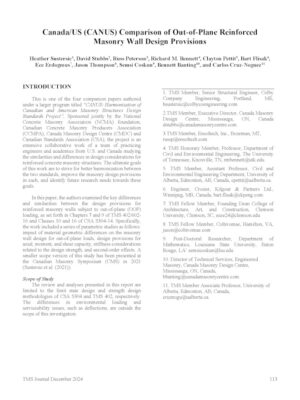
  • Comparison of Out-of-Plane Reinforced Masonry Wall Design Provisions

    Comparison of Out-of-Plane Reinforced Masonry Wall Design Provisions

    $25.00 (PDF)

    Heather Sustersic, David Stubbs, Russ Peterson, Richard M. Bennett, Clayton Pettit, Bart Flisak, Ece Erdogmus, Jason Thompson, Semsi Coskun, Bennett Banting, Carlos Cruz-Noguez

    TMS Journal Volume 42, December 31, 2024

    Abstract

    As part of a larger project jointly sponsored by the National Concrete Masonry Association (NCMA) Foundation, Canadian Concrete Masonry Producers Association (CCMPA), Canada Masonry Design Centre (CMDC) and Canadian Standards Association (CSA), a team of engineers and researchers from U.S. and Canada worked together to examine the key differences and similarities between the design provisions for reinforced masonry walls subject to out-of-plane (OOP) and axial loads. The scope was limited to the strength design provisions of TMS 402-16 and the limit state design provisions of CSA S304-14 masonry design standards. Several parametric studies were conducted to quantify the comparisons, as well as to identify possible limitations within each code. These studies explored factors that directly impact the calculation of combined flexural and axial capacity, wall stiffness, second-order moments, and shear capacity of the masonry walls subjected to OOP loading. Parameters considered include the compressive strength of the masonry assembly, wall geometry, as well as the size, strength and spacing of the steel reinforcement. In general, it was found that the Canadian provisions are more conservative than those in the U.S. The paper also provides a list of areas of further research or code revisions that should be considered in the future. It is the team’s goal to propose improvements to both codes as a result of this work.

    Keywords: Flexure, Axial Capacity, Out-of-Plane Resistance of Walls, Reinforced Masonry Walls, Strength Design, TMS 402, CSA S304


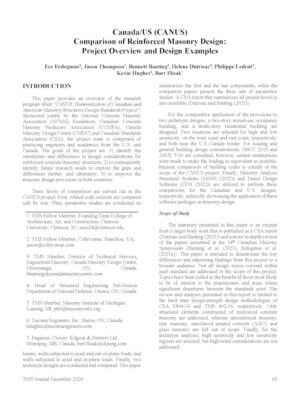
  • Comparison of Reinforced Masonry Design: Project Overview and Design Examples

    Comparison of Reinforced Masonry Design: Project Overview and Design Examples

    $25.00

    Authors: Ece Erdogmus, Jason Thompson, Bennett Banting, Helene Dutrisac, Philippe Ledent, Kevin Hughes, Bart Flisak

    TMS Journal Volume 42, December 31, 2024

    Abstract

    This work is the first one of the four companion papers associated with the Canada/US (CANUS) collaborative project: Harmonization of Canadian and American Masonry Structures Design Standards. This paper provides an overview of the key differences in reinforced concrete masonry design provisions between the two countries. The first part of the paper summarizes these differences in a discussion format, while the second part provides two design examples: a two-story mixed-use occupancy building and a multi-story residential building. Two locations are selected for high and low seismicity. While the critique of the building codes is out of the scope of this study, when appropriate, differences regarding the loading considerations from NBCC 2015 and ASCE 7-16 are highlighted. In some cases, the corresponding design checks align closely between the two countries’ design standards, while in other cases there are minor to significant differences. There are also instances where one of the standards is silent on a topic while the other addresses it comprehensively. In general, it is observed that TMS 402-16 allows a larger applicability of masonry design compared to CSA S304-14 due to the compounding effect of lower trust in masonry’s material strength and stricter considerations in design equations.

    Keywords: Reinforced masonry design, masonry codes, compressive strength of masonry, TMS 402-16, CSA S304-14


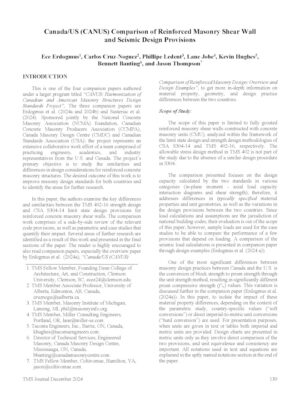
  • Comparison of Reinforced Masonry Shear Wall and Seismic Design Provisions

    Comparison of Reinforced Masonry Shear Wall and Seismic Design Provisions

    $25.00 (PDF)

    Authors: Ece Erdogmus, Carlos Cruz-Noguez, Phillipe Ledent, Lane Jobe, Kevin Hughes, Bennett Banting, Jason Thompson

    TMS Journal Volume 42, December 31, 2024

    Abstract

    As part of a larger project titled, CANUS: Harmonization of Canadian and American Masonry Structures Design Standards Project, in this paper, the design provisions in TMS 402-16 and CSA S304-14 are compared for reinforced concrete masonry shear walls subject to in-plane forces. The scope of the work covers in-plane bending and axial force interactions, shear capacity calculations, and seismic provisions for fully grouted reinforced concrete masonry shear walls. Seven parametric studies and two case studies are utilized to quantify the impact of some of the differences. The parametric studies include exploration of the effects of the wall aspect ratio, compressive strength of masonry, maximum reinforcement limitations and ductility requirements, material or capacity reduction factors, maximum compressive strain, and the artificial moment arm reduction considerations, as well as seismic wall categories and prescriptive seismic detailing requirements. The authors find that in most cases, the Canadian approach is more conservative than the U.S. The main contributor to this discrepancy is a large difference in the typical masonry compressive strength (f’m) values used in Canada and the U.S. By contrast, the maximum reinforcement ratio combined with a lower maximum strain in U.S. design can limit the height of reinforced masonry walls, especially in high seismic areas. The main product of this project is a list of potential future research studies for the resolution of some of the issues highlighted in this paper that can help improve and harmonize both countries’ masonry design provisions.

    Keywords: Reinforced masonry shear walls, TMS 402, CSA S304, In-plane behavior of masonry shear walls, Seismic design of shear walls


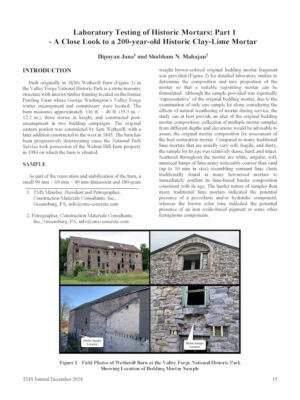
  • Laboratory Testing of Historic Mortars: Part 1 – A Close Look to a 200-year-old Historic Clay-Lime Mortar

    Laboratory Testing of Historic Mortars: Part 1 – A Close Look to a 200-year-old Historic Clay-Lime Mortar
    $25.00 (PDF)

    Authors: Dipayan Jana, Shubham N. Mahajan

    TMS Journal Volume 42, December 31, 2024

    Abstract

    A large stone barn built in 1820s in the Valley Forge historic national park in Pennsylvania used some of the early historic lime mortars in the US masonry construction during the time when natural cement was just produced in the US and about to gain its momentum for next 70 years, and Portland cement, though formulated in Europe, didn’t enter the US market for at least 50 years. A brown original fist-size bedding mortar fragment was examined, which showed many interesting microstructures of a clay-mixed historic lime mortar. The fragment was examined by a plethora of analytical techniques encompassing optical and scanning electron microscopy and microanalysis, acid digestion, chemical (gravimetric) analysis, XRD, XRF, thermal studies (TGA, DSC, DTG), FTIR, and ion chromatography. Such a comprehensive investigation provided detailed information about the mortar type, composition, and grain size distribution of masonry sand, original non-hydraulic dolomitic lime plus clay-based binder compositions and resultant microstructure of paste, origin of lime lumps, along with evidence of any distress and alterations from two centuries of exposures to a moist outdoor environment. Based on all these studies, the overall condition, extent of deterioration/alterations, and sand and binder proportions of the original mortar were assessed by reverse engineering, from which a suitable replacement mortar was recommended for long-term restoration.

    Keywords: Microscopy, petrography, masonry, historic mortar, lime


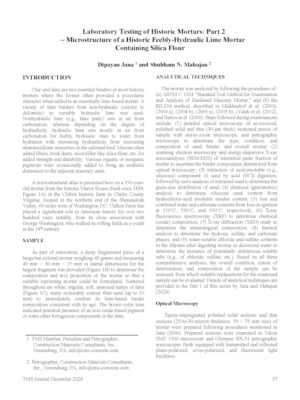
  • Laboratory Testing of Historic Mortars: Part 2 – Microstructure of a Historic Feebly-Hydraulic Lime Mortar Containing Silica Flour

    Laboratory Testing of Historic Mortars: Part 2 – Microstructure of a Historic Feebly-Hydraulic Lime Mortar Containing Silica Flour

    $25.00 (PDF)

    Authors: Dipayan Jana, Shubham N. Mahajan

    TMS Journal Volume 42, December 31, 2024

    Abstract

    A large stone barn built in 1820s in the Valley Forge historic national park in Pennsylvania used some of the early historic lime mortars in the US masonry construction during the time when natural cement was just produced in the US and about to gain its momentum for next 70 years, and Portland cement, though formulated in Europe, didn’t enter the US market for at least 50 years. A brown original fist-size bedding mortar fragment was examined, which showed many interesting microstructures of a clay-mixed historic lime mortar. The fragment was examined by a plethora of analytical techniques encompassing optical and scanning electron microscopy and microanalysis, acid digestion, chemical (gravimetric) analysis, XRD, XRF, thermal studies (TGA, DSC, DTG), FTIR, and ion chromatography. Such a comprehensive investigation provided detailed information about the mortar type, composition, and grain size distribution of masonry sand, original non-hydraulic dolomitic lime plus clay-based binder compositions and resultant microstructure of paste, origin of lime lumps, along with evidence of any distress and alterations from two centuries of exposures to a moist outdoor environment. Based on all these studies, the overall condition, extent of deterioration/alterations, and sand and binder proportions of the original mortar were assessed by reverse engineering, from which a suitable replacement mortar was recommended for long-term restoration.

    Keywords: Microscopy, petrography, masonry, lime


  • Historical Masonry Workshop Recordings

    Historical Masonry Workshop Recordings

    $300.00

    This program is intended for any Owner, Architect, Engineer or Contractor who is assessing/purchasing/stabilizing/renovating an existing (especially an historic) building with masonry wall (including load-bearing/non-load-bearing/veneers) such as brick. stone or concrete masonry units. This program will specifically provide attendees with the fundamental skills necessary to understand how the following impact existing masonry structures:

    • Differing Architectural Approaches to Historical Restorations
    • Structural Functions of Masonry Walls
    • Building Code Evaluations of Existing Buildings
    • Investigation Techniques and Standards
    • Mortar Repointing and Crack Repair Techniques
    • Retrofit Veneer Anchor System
    • Lateral Restraint Anchors and Bracing Systems

    This program was presented on April, 12, 2013 at the University of Texas – Brownsville Campus. Speakers include Alan Pettingale, Andreas Stavridis, Benchmark Harris, Michael Schuller, and Gordon Shepperd. The recordings listed below can be purchased individually or together at a 25% discount. Parts 1 & 14 are available for free.


    All proceeds from sales of these recordings will go toward the Clayford T. Grimm, P.E. Student Scholarship.

    This product will provide access to all workshop recordings.
    To purchase individual recordings, use the links in the table below.
  • Masonry is Sustainable Brochure (2014)

    Masonry is Sustainable Brochure (2014)

    $0.00

    This publication reviews the positive environmental attributes of masonry products, both within the LEED rating system, and beyond LEED with a broader approach to sustainable buildings.


  • Placeholder

    New TMS Membership

    Price range: $40.00 through $2,250.00

    Membership Classifications & Dues Rates Sustaining Organization ($2,250) An individual or organization with an interest in the goals and activities of the Society and who wishes to make a significant…

    Select optionsLoading Done This product has multiple variants. The options may be chosen on the product page
  • Overview of Changes in TMS 402/602-22 and Review of the Specification for Masonry Structures

    Overview of Changes in TMS 402/602-22 and Review of the Specification for Masonry Structures

    $80.00

    During this five-part recorded webinar series, masonry experts and Committee leaders review the new standards TMS 402-22 Building Code Requirements for Masonry Structures and TMS 602 Specification for Masonry Structures and changes made since the 2016 edition. These standards will form the basis for masonry design provisions in the 2024 International Building Code and other model building codes and include some major new provisions that include a new appendix on masonry partition walls reinforced with Glass Fiber Reinforced Polymer (GFRP) reinforcement, completely revised anchored and adhered veneer provisions, and enhancements throughout the standards.

    Topics covered in this series include:

    • Overview of Changes in TMS 402/602-22 and Review of the Specification for Masonry Structures
    • Major Structural Design Changes in TMS 402/602-22
    • Seismic/Limit States Design per TMS 402/602-22
    • Masonry Veneer Requirement Changes in TMS 402/602-22, A Whole New Chapter
    • Using the New Appendix D on Composite Reinforcement in Masonry

    Save 10% when purchasing all 5 webinars