The most widely used masonry textbook, Masonry Structures, Behavior and Design, by Dr. Ahmad Hamid has been revised to discuss new research findings and to reflect the design provisions in the TMS 402/602-16.
The textbook also includes numerous design examples (based on the strength design method) and two buildings designs of a single-story building and a multistory building. This textbook is ideal for undergraduate and graduate level courses and it is an exceptional reference for practicing designers.
The MDG-2016 is an excellent resource for designers as well as students learning about masonry because it:
was developed by dozens of masonry experts who are familiar both with masonry design and with the Code requirements governing masonry’s use
includes over 110 practical examples of typical masonry buildings and components
provides practical tips on how to quickly and efficiently design typical masonry
includes drawings and photographs to illustrate concepts and procedures discussed
Topics covered in the 21 chapters of the MDG-2016 include masonry materials, testing, quality assurance, quality control, construction methods, structural design, seismic design, and using the TMS 402/602 with model Building Codes. A companion website provides users with additional resources including a digital copy of the MDG-2016, Excel spreadsheets used in some of the design examples and select technical notes on clay brick and concrete masonry that are often used by designers.
Available Formats
Choose from print, digital, or online access through TMS or our distribution partners:
Access Type
Through TMS
Through Partners
Print
Hard Copy
*Hard copies come with a registration card that grants free access to the digital edition
If you have difficulty or are not satisfied with the digital version, we’re happy to exchange it for a hard copy or issue a refund. Just reply to your receipt, or message the email above.
Masonry Basics, 2nd Edition has been completely revised and updated. It serves as an introduction to masonry design and construction. The various component materials, the ways in which the components are assembled to form the masonry construction, and the weather-resistance and structural implications of the various types of masonry assemblies are described. Highlights of quality assurance and quality control issues are addressed and a few of the most common types of potential deficiencies in masonry construction are described so they can be avoided. Finally, a glossary of masonry terms used in the text is provided.
Masonry Basics can serve as a beginning text for architects, engineers, contractors, building officials, inspectors, building owners, or anyone else who wants to learn the basics of this industry.
This product is provided as a secure PDC file and can only be opened through the Locklizard Safeguard Viewer. Other PDF Viewers will not be able to read this file. This document can only be opened by a single user and allows limited printing of up to 2 watermarked copies. Read more about these limitations.
Design and Construction Guidelines for Dry-Stack Concrete Masonry was developed as a non-mandatory aid for designers, building officials, contractors, educators, and others interested in dry-stack masonry construction.
Dry-stack masonry construction, which consists of individual masonry units placed without the use of mortar in the head and bed joints, is one of the earliest forms of construction. Despite its historical use, there is little in the way of contemporary design and construction guidance in the United States on the use of dry-stack masonry systems for structural applications. Because the majority of dry-stack research has been limited to reinforced or prestressed concrete masonry construction, the scope of this guide is limited to reinforced or prestressed, dry-stack construction of concrete masonry units.
Key updates and revisions incorporated by the Committee include:
Updates for coordination with other reference standards including updates to reflect changes in ASTM standards and reference to the 2022 edition of ASCE/SEI 7.
General cleanup and clarification of provisions and expanded commentary.
Introduced new deflection limits of l/600 for cast stone subjected to out-of-plane loads.
Removed the historical drying shrinkage limit of 0.000325, replaced by a requirement that drying shrinkage be tested and reported.
Minimum thickness requirement of 2.5 inches (64 mm) for all cast stone units.
Permitting the use of glass fiber reinforced polymer bars meeting ASTM D7957/C7957M.
Minimum qualifications for testing labs and inspection agencies are required to be defined.
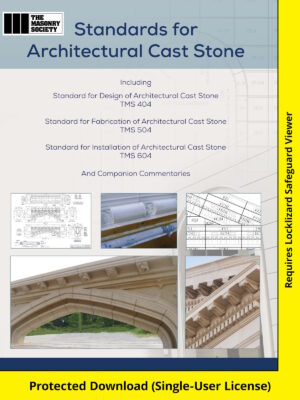
Standards for Architectural Cast Stone contains three standards and their commentaries:
TMS 404 covers the design of structures and assemblies incorporating or consisting of cast stone products and elements. Among the subjects covered are: definitions; contract documents; project drawings; design loads; material properties; strength and serviceability; analysis and design; section properties; reinforcement detailing; and quality assurance.
TMS 504 covers the fabrication of cast stone products and elements. Among the subjects covered are: ASTM standards; shop drawings; material properties; reinforcing steel; detailing; anchors; ties; corrosion protection; and delivery.
TMS 604 covers the installation of cast stone assemblies and elements. Among the subjects covered are: installation; construction; submittals; materials; mortars; masonry; quality assurance; inspection; and tolerances.
The updated version of this Standard provides minimum requirements for rating masonry walls for a sound transmission class (STC) and added for 2012 outdoor-indoor transmission class (OITC) based on field or laboratory testing or based on a calculation procedure.
This product is provided as a secure PDC file and can only be opened through the Locklizard Safeguard Viewer. Other PDF Viewers will not be able to read this file. This document can only be opened by a single user and allows limited printing of up to 2 watermarked copies. Read more about these limitations.
The Masonry Society’s “Guide for Condition Assessment of Masonry Facades” is a living document that describes methodology for inspection and assessment of masonry facades. The Guide is useful to building owners, architects, engineers, and building officials as a valuable tool for masonry façade evaluations related to façade ordinances, restoration and repairs, maintenance programs, and due diligence reports. Starting with a discussion of the factors that affect masonry performance, the Guide continues through the process of masonry façade inspection and assessment with a flow chart and outline of the various tasks and elements of a façade assessment. The Appendix includes special attention on the topics of “Distress Common to Terra Cotta Facades” and “Assessment Techniques of In-Place Masonry”.
This product is provided as a secure PDC file and can only be opened through the Locklizard Safeguard Viewer. Other PDF Viewers will not be able to read this file. This document can only be opened by a single user and allows limited printing of up to 2 watermarked copies. Read more about these limitations.
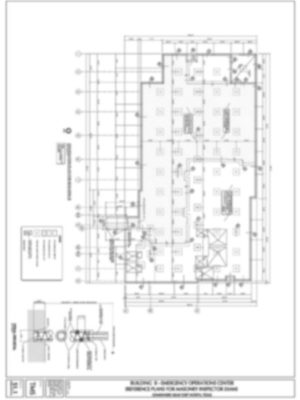
This package includes a set of basic structural plans with a sample quiz to help prepare candidates for the plan reading portion of the ICC/TMS Structural Masonry Special Inspection Examination. The sample quiz includes 8 questions with answers based on the plan set.
This product is provided as a secure PDC file and can only be opened through the Locklizard Safeguard Viewer. Other PDF Viewers will not be able to read this file. This document can only be opened by a single user and allows limited printing of up to 2 watermarked copies. Read more about these limitations.
The Masonry Designers’ Guide – 2022 (MDG-2022) is a valuable reference for engineers, contractors, architects, inspectors, building code authorities, and educators. Initial chapters address materials, testing, quality assurance, quality control, and construction methods with reference to specific provisions of the 2022 TMS 402 Code and TMS 602 Specification. Subsequent chapters illustrate fundamental design concepts and demonstrate how to apply Code provisions to structural design of common masonry members. The MDG-2022 also includes discussion on masonry provisions in the 2024 International Building Code (IBC) and its examples are based on ASCE /SEI 7-22.
More than 150 design examples included discuss concrete and clay masonry, autoclaved aerated concrete (AAC) masonry, prestressed masonry, glass unit masonry and more. The final three chapters of the book include 60+ comprehensive design examples for three common masonry buildings (Chapters 19-21).
 Reinforced Masonry Engineering Handbook, 9th Edition
  TMS 402/602-16 Building Code Requirements and Specification for Masonry Structures
  Masonry Designers' Guide – 2022
  TMS 402/602-16 Online - Annual Subscription
  TMS eJournal, Vol. 8, No. 2
  Masonry Basics, 2nd Edition
  TMS 402/602-08 Building Code Requirements and Specification for Masonry Structures, 2008 (MSJC 2008)
  Guide for Condition Assessment of Masonry Façades, 2017 - Download Version